West of the Nile valley, Egypt becomes desert for hundreds of kilometres, broken only by a handful of oases. It is a completely different country from the temples and the river: chalk towers, black volcanic hills, salt lakes, hot springs and dunes that run all the way to Libya. For travellers who have seen the Pyramids and Luxor, or who simply want a few days of open space, the Western Desert is the most rewarding addition to an Egypt trip.
This guide covers the four places most visitors go, how far each is from Cairo, and how many days each needs.
Fayoum: the easy introduction
Fayoum is the closest, about two hours south-west of Cairo, and it works as a day trip. The highlights lie beyond the green oasis itself. Wadi El Rayan has two desert lakes joined by small waterfalls. Wadi El Hitan, the Valley of the Whales, is a UNESCO World Heritage Site where fossil whales around 40 million years old lie in the sand along a marked trail. On the way back, the pottery village of Tunis looks over Lake Qarun.
Time needed: one long day. See the Fayoum Oasis Day Tour.
Bahariya and the White Desert
Bahariya Oasis is around four to five hours from Cairo by road, and it is the gateway to the White Desert National Park. The route from Bahariya by 4×4 passes through the Black Desert, where volcanic hills are scattered across the sand, and Crystal Mountain, a ridge of quartz crystal. Then the ground turns white: wind-carved chalk formations in the shapes of towers and mushrooms, glowing at sunset.
Most visitors camp a night in the White Desert. The camps are simple, with mattresses, blankets and a windbreak, and dinner is cooked over the fire under a sky full of stars. It is basic, not a hotel, and that is the point.
Time needed: two days and one night from Cairo, or three days to slow down. See the 2-Day White Desert and Bahariya Camping Tour, and read more in Camping in Egypt.
Siwa: the remote one
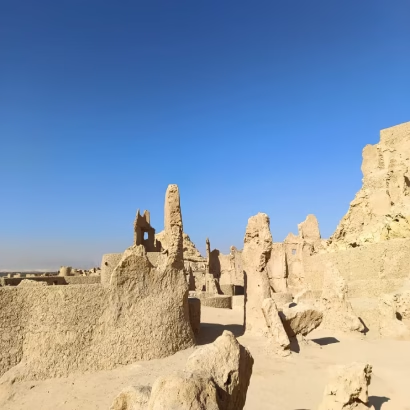
Siwa lies near the Libyan border, a long day’s drive from Cairo via the Mediterranean coast, around nine to ten hours each way. That distance is exactly why it feels so different. Siwa has its own Amazigh language and traditions, palm groves and salt lakes, and the ruins of Shali, a town built of salt and mud brick. Above the oasis stands the Temple of the Oracle of Amun, where Alexander the Great came for answers. There is also the Mountain of the Dead, with its rock-cut tombs, Cleopatra’s Spring, and sunset at Fatnas. Beyond the oasis, the dunes of the Great Sand Sea begin, best explored by 4×4.
Time needed: four days and three nights at minimum, because the first and last days are mostly travel. See the 4-Day Siwa Oasis Tour from Cairo, and our Siwa Oasis guide. You can break the drive with a night on the coast at El Alamein, home to the Second World War museum and memorials.
Which desert trip should you choose?
- One spare day: Fayoum.
- Two days, and you want the classic desert experience: the White Desert, with a night under the stars.
- Four days or more, and you want somewhere truly remote: Siwa.
When to go, and what to bring
The best months are roughly October to April. Summer days in the desert are fiercely hot, and the White Desert in particular is best avoided in midsummer. Winter has the opposite problem: warm afternoons but cold nights, close to freezing in the desert in December and January. Whatever the season, bring warm layers for the evening, a hat, sunglasses, sun cream, a scarf for dust and wind, a torch and plenty of water.
And remember that the desert runs on its own clock. Roads are long, and the best moments, sunset in the White Desert or a quiet evening at Fatnas, cannot be rushed. Leave time for them.
All of our desert trips are private and quoted on request. Browse our Egypt land tours and day tours, or ask us to combine a desert trip with your Nile cruise.
“Not sure which cruise to choose? Tell us your dates and budget.”
Not sure which Nile cruise is right for you?
Answer a few quick questions and we will match you with the best ships for your trip.