Every Nile cruise passes through the same moment. You walk into your third or fourth temple, look up at a wall covered in carved figures and hieroglyphs, and realise that it all looks the same. A king, a god, a row of symbols, another king, another god. Your guide is explaining, but the group is moving on, and the wall stays a beautiful mystery.
It does not have to be like that. Egyptian temples were built to a system, and the scenes on their walls follow rules that were repeated for three thousand years. Once you know a handful of those rules, the walls start to talk. You can tell which god a temple belongs to before your guide says it. You can spot the king’s name in a cartouche, read the direction of a line of hieroglyphs, and understand why one figure is twice the size of another.
This guide is the field manual we wish every traveller had before they reached Karnak. Read it before your cruise, or keep it open on your phone as you walk. It covers the layout of a temple, the gods you will meet on a Nile cruise, the symbols that appear everywhere, how to read a scene, and how to start reading hieroglyphs yourself.
Part 1: Why every temple looks the same (and why that helps you)
An Egyptian temple was not a place where ordinary people gathered to worship. It was the house of a god, and the god lived in the sanctuary at the very back, in the form of a statue looked after by priests. Everything about the building was designed to lead from the outside world, full of chaos, towards that hidden, sacred room.
That is why almost every temple you visit, from Karnak to Edfu to Philae, has the same basic plan. Walk through it in order and you are walking the route the priests walked.
The pylon
The great gateway at the front is the pylon: two massive sloping towers with a doorway between them. The shape is not decorative. It copies the hieroglyph for the horizon, two mountains with the sun rising between them. As the sun came up behind the pylon, the temple was reborn every morning. Look at the outer face and you will usually find a huge scene of the king smiting his enemies, a statement to everyone outside that he kept chaos away from the god’s house. At Edfu, the pylon is complete and you can see this scene at full scale.
The open court
Behind the pylon is an open courtyard, often lined with columns. This was as far as most people would ever get, and even then only on festival days. At Luxor Temple, the court of Ramesses II still has colossal statues of the king between the columns.
The hypostyle hall
Next comes a hall packed with columns, the hypostyle hall. It represents the marsh that grew around the first mound of land at the creation of the world, which is why the columns are carved as giant papyrus and lotus plants. The most famous example is the Great Hypostyle Hall at Karnak, with 134 columns, but the halls at Edfu, Dendera and Esna are often better preserved, with colour still on the ceilings.
The offering halls and the sanctuary
Beyond the hall, the rooms get smaller, darker and more private. There are halls where offerings were prepared, storerooms, and finally the sanctuary, where the god’s statue stood in a shrine. At Edfu, a granite shrine still stands in the sanctuary. Only the king and the senior priests were allowed this far.
The trick in the architecture
Next time you walk through a temple, notice three things happening at once. The floor rises a little with each section. The ceiling gets lower. And the light fades, from the full sun of the court to near darkness in the sanctuary. The effect is deliberate: you are climbing the primeval mound of creation towards the god, moving from the human world into the divine one. Once you have seen it at one temple, you will feel it in every temple after.
Columns that tell you where you are
Columns are worth a second look, because their tops, the capitals, change from temple to temple.
- Open papyrus capitals flare out like an open flower. You will see them in the central aisle of Karnak’s hypostyle hall, where more light fell.
- Closed papyrus capitals look like a bud. They line the side aisles at Karnak and the colonnades at Luxor Temple.
- Composite capitals, with layers of different plants, are typical of the later Ptolemaic temples, like Edfu, Esna and Philae. Each one can be different.
- Hathor capitals carry the face of the goddess Hathor, with cow’s ears, on four sides. Dendera has the finest.
- Osiride pillars are not columns at all, but square pillars with a statue of the king in the form of Osiris, arms crossed over his chest. You will find them at the Ramesseum, Medinet Habu and inside the Great Temple at Abu Simbel.
Part 2: Who’s who on the walls
The fastest way to make sense of a temple is to recognise the gods. Each one has a fixed look: a particular head, crown or object. Learn the dozen below and you will be able to identify most of the figures you meet between Luxor and Aswan.
One tip before you start: look at the head and the crown first. Bodies are usually human and the clothing is similar, but the head and the crown are the god’s signature.
The family of Thebes: Amun, Mut and Khonsu
Amun is the great god of Thebes, modern Luxor, and you will see him more than anyone else. Look for a man wearing a flat-topped crown with two tall plumes. His skin is sometimes painted blue. He is often merged with the sun god as Amun-Ra, king of the gods. Karnak was his home, and Luxor Temple was built for his annual festival.
Mut is his wife. She wears a vulture headdress, often with the double crown of Egypt on top. Khonsu, their son, is the moon god: a young man with a sidelock of hair and a moon disc and crescent on his head, often wrapped like a mummy. Together the three form the Theban triad, and you will find them side by side at Karnak.
Horus, the falcon
Horus has the head of a falcon, usually wearing the double crown of Upper and Lower Egypt. He is the son of Isis and Osiris, and the king was believed to be Horus on earth. Edfu is his great temple, and its walls tell the story of his battles with his uncle Seth. Do not confuse him with Ra-Horakhty, the sun god, who also has a falcon head but wears a sun disc circled by a cobra. At Kom Ombo, the falcon god who owns one half of the double temple is Haroeris, Horus the Elder.
Isis and Osiris
Isis is the great mother goddess. In older scenes she wears a small throne on her head, which is also the hieroglyph of her name. In later scenes she often wears cow horns with a sun disc between them, borrowed from Hathor. Philae, near Aswan, is her temple.
Osiris, her husband, is god of the dead and of rebirth. He is the easiest god to recognise: wrapped like a mummy, holding the crook and flail, wearing a tall white crown with feathers, the atef. His skin is often green or black, the colours of new growth and fertile soil. His cult centre was Abydos, and the Temple of Seti I there is full of him.
Hathor, the cow goddess
Hathor is goddess of love, music and joy. She appears as a woman with cow horns and a sun disc, as a cow, or as a face with cow’s ears, the form used on the Hathor columns at Dendera, her great temple. Yes, her crown looks like Isis’s later crown. Context helps: at Dendera it is almost always Hathor; at Philae it is almost always Isis. Hathor also has a beautiful chapel inside the Temple of Hatshepsut.
Sobek, the crocodile
Sobek has the head of a crocodile, often with a sun disc and plumes. Crocodiles were once common along the Nile, and Sobek was worshipped where they gathered. He shares the double temple of Kom Ombo with Haroeris, each with his own entrance, hall and sanctuary. The mummified crocodiles in the museum next door were sacred to him.
Khnum, the potter
Khnum has the head of a ram, with long, wavy horizontal horns. He was believed to shape people on a potter’s wheel, and some scenes show him doing exactly that. He was worshipped at Elephantine in Aswan, near the Nile’s First Cataract, and at Esna, where cleaning in recent years has revealed the brilliant colour of the temple’s ceiling.
Thoth, Anubis and the guardians of knowledge and death
Thoth, god of writing and wisdom, has the head of an ibis, a wading bird with a long curved beak. He is often shown holding a scribe’s palette, or recording the result when a dead person’s heart is weighed. Sometimes he appears as a baboon instead.
Anubis, god of embalming and protector of the dead, has the head of a black jackal. You will see him most in tombs, in the Valley of the Kings and the Valley of the Queens, leaning over a mummy or guiding the dead.
Ptah, Sekhmet, Maat and Bes
- Ptah, the creator god of Memphis, is shown as a man wrapped like a mummy, with a close-fitting skullcap and a straight beard, holding a sceptre that combines three symbols.
- Sekhmet has the head of a lioness and a sun disc. She was a fierce goddess of war and healing.
- Maat, goddess of truth and cosmic order, wears a single ostrich feather on her head. The king is often shown offering a small figure of Maat to a god: he is presenting order itself.
- Bes is unlike the others: a stocky dwarf with a lion-like face and his tongue often sticking out, shown face-on. He protected households, mothers and children, and appears in the birth houses at Dendera and Philae.
Which god belongs to which temple
- Karnak: Amun, Mut and Khonsu.
- Luxor Temple: Amun, during his annual Opet festival.
- Edfu: Horus.
- Kom Ombo: Sobek and Haroeris.
- Esna: Khnum.
- Philae: Isis.
- Dendera: Hathor.
- Abydos: Osiris, with several other gods given their own chapels.
For the history of each site, read our guides to Karnak, Edfu, Kom Ombo, Esna, Philae, Dendera and Abydos.
Part 3: The symbols you will see everywhere
A small set of symbols appears on almost every wall. They are often held by gods, offered by kings or carved over doorways, and each one carries a clear meaning.
- Ankh: a cross with a loop at the top. It means “life”. Gods often hold it to the king’s nose, giving him the breath of life.
- Was sceptre: a long staff with a forked base and an animal head at the top. It means “power” or “dominion” and is carried by gods.
- Djed pillar: a column with four horizontal bars at the top, linked to Osiris and read as his backbone. It means “stability”.
- Crook and flail: held crossed over the chest by Osiris and by kings. The crook is the shepherd who guides; the flail is authority.
- Winged sun disc: a sun with a cobra on each side and long outstretched wings. It is carved over doorways and on ceilings as protection. Look up as you walk through any gateway at Edfu and you will see it.
- Uraeus: the rearing cobra on the king’s forehead, ready to spit fire at his enemies.
- Scarab: the dung beetle, which pushes a ball of dung as the sun was pushed across the sky. It stands for the rising sun and rebirth, and for the god Khepri.
- Eye of Horus (wedjat): an eye with markings below like a falcon’s cheek. It means protection and healing.
- Shen ring: a circle of rope with a straight line at the bottom. It means eternity, and when stretched into an oval it becomes the cartouche around a king’s name.
- Sema-tawy: a papyrus plant and a lotus tied together around a central sign, often on the sides of thrones. It means the union of the Two Lands, Upper and Lower Egypt. Sometimes two gods, usually two Nile figures, are shown tying the knot.
Crowns: reading the king’s headgear
The crown tells you what role the king or god is playing in the scene.
- White crown: tall and bottle-shaped. The crown of Upper Egypt, the south.
- Red crown: flat-topped, with a tall spike at the back and a curl at the front. The crown of Lower Egypt, the north.
- Double crown: the white crown set inside the red. Rule over all of Egypt.
- Blue crown (khepresh): a rounded helmet-like crown, often studded with discs. Worn especially in scenes of war and ceremony in the New Kingdom.
- Nemes: the striped headcloth falling to the shoulders, the one on Tutankhamun’s golden mask and on the Sphinx.
- Atef: the white crown flanked by two feathers, worn by Osiris.
What the colours mean
Where paint survives, as at Dendera, Esna, Medinet Habu and in the royal tombs, colour carries meaning. Green is new life and regeneration. Black is the fertile soil of the Nile and rebirth, not death. Red can mean energy and life, but also the desert and danger. Blue is the sky and the waters. Gold, or yellow, is the flesh of the gods, which was believed to be made of gold. Men are usually painted with darker reddish-brown skin and women with lighter yellowish skin, a convention rather than a portrait.
Part 4: How to read a scene
Most temple walls are covered in scenes of the king meeting the gods. They can look identical, but each one is a small, precise statement. Ask these questions and you can decode almost any of them.
Who is facing whom?
The standard scene has the king on one side and one or more gods on the other, facing each other. The king is usually doing something: offering bread, wine, incense, flowers or a figure of Maat. The gods are usually giving something back: life, power, a long reign, often by holding an ankh towards him. The message is a deal. The king looks after the gods, and the gods look after Egypt.
Who is biggest?
Size is importance, not distance. Gods and the king are the largest figures. Queens are often smaller, children smaller still, and enemies and ordinary people smallest of all. There is no perspective in the modern sense. On the battle scenes at Abu Simbel and the Ramesseum, the king in his chariot is many times the size of anyone else on the battlefield.
Why do the figures look so strange?
Egyptian artists did not draw what one eye sees from one place. They showed each part of the body from its most recognisable angle: the head in profile, the eye from the front, the shoulders from the front, the legs and feet in profile. The result looks odd at first, but it is a complete, eternal record of the person, which was the point.
Registers: reading in strips
Large walls are divided into horizontal bands, called registers, like the panels of a comic. Each register is a separate scene or a step in a sequence. Read them one band at a time.
Sunk relief and raised relief
Run your eye along a wall without touching it and you will see two techniques. In raised relief, the background is cut away so the figures stand out. In sunk relief, the figures are cut into the surface. Sunk relief was quicker and casts strong shadows in bright sunlight, so it was widely used on outside walls. Raised relief is often finer, and was favoured inside. Ramesses II used a great deal of sunk relief, and in places he had the scenes of earlier kings recut with his own name.
The famous scenes to look out for
- The smiting scene on pylons: the king grabs a group of enemies by the hair and raises a mace. It is a symbol of order beating chaos, repeated for thousands of years.
- The Battle of Kadesh, Ramesses II’s war against the Hittites, told again and again on his monuments, including Luxor Temple, the Ramesseum and Abu Simbel.
- The Opet festival at Luxor Temple: the procession of Amun’s sacred boat from Karnak to Luxor, with musicians, dancers and offerings.
- The Punt expedition at the Temple of Hatshepsut: ships, incense trees and the people of a distant land.
- The Horus and Seth story at Edfu, along the inner walls.
- The Dendera ceiling, with the sky goddess Nut stretched across it, swallowing the sun at night and giving birth to it in the morning.
Part 5: Reading hieroglyphs (yes, you can start)
Nobody learns to read hieroglyphs on a two-week holiday. But you can learn enough to find your way around an inscription, spot a king’s name and read a few signs on your own, and that changes how a wall feels.
Which way do you read?
Hieroglyphs can run left to right, right to left, or in columns from top to bottom. The trick is simple: look at the way the people and animals are facing, and read towards their faces. If the birds and figures face left, start from the left. Inscriptions often face the figure they describe, so the words beside a god usually point in the same direction as that god.
Three kinds of sign
Egyptian writing mixed three kinds of signs together, which is why it took so long to decipher.
- Sound signs spell out sounds, like our alphabet. About two dozen signs stand for a single sound each.
- Word signs stand for a whole word: a drawing of a sun can simply mean “sun”.
- Determinatives are silent signs placed at the end of a word to show what kind of thing it is: a seated man for a person, walking legs for movement, a scroll for an abstract idea. They work like a visual category label.
A starter alphabet
These are some of the single-sound signs you will see again and again. Try to spot them on the next wall you see.
- Vulture: a glottal sound, written as “a” by most beginners.
- Flowering reed: “i”.
- Quail chick: “w” or “u”.
- Foot: “b”.
- Stool: “p”.
- Horned viper: “f”.
- Owl: “m”.
- Water ripple: “n”.
- Mouth: “r”.
- Folded cloth: “s”.
- Basket with a handle: “k”.
- Loaf of bread: “t”.
- Hand: “d”.
- Cobra: “dj”.
- Lion: used in later times for “l”, as in the names of Ptolemy and Cleopatra.
Egyptian writing left out most vowels, so words were written as consonants. Egyptologists fill in an “e” to make them pronounceable, which is why spellings like Ramesses, Ramses and Rameses all exist.
Cartouches: finding the king
The oval ring with a line at the bottom is the cartouche, and inside it is a royal name. This is the one piece of a wall you can always find. Kings had several names, and two of them were written in cartouches.
- The throne name, taken when the king came to the throne, is introduced by a sedge plant and a bee: “King of Upper and Lower Egypt”.
- The birth name, the name he was born with, is introduced by a duck and a sun disc: “Son of Ra”.
Sun discs inside a cartouche usually spell “Ra”, the sun god, part of so many royal names. Out of respect, the god’s name was often written first, even if it was spoken later. And when you see a cartouche that has been chiselled out, someone wanted that king or queen forgotten. Hatshepsut and Akhenaten both suffered this.
The famous breakthrough came from cartouches. The Rosetta Stone, now in the British Museum, carried the same decree in hieroglyphs, a later Egyptian script and Greek. Comparing the name Ptolemy in its cartouches with the name Cleopatra on an obelisk from Philae helped Jean-François Champollion crack the system in 1822.
Part 6: The layers that came after the pharaohs
Temples did not freeze when the last pharaoh died. They were used, reused and written on for centuries, and spotting those later layers is part of the fun.
- Greek and Roman rulers built many of the temples you see on a cruise. Edfu, Kom Ombo, Esna, Dendera and much of Philae are Ptolemaic or Roman. The rulers were Greek-speaking, but they had themselves carved as traditional pharaohs, so their cartouches contain names like Ptolemy, Cleopatra, Augustus and Tiberius.
- Christian Egypt turned some temples into churches. You will see crosses carved into walls, and at Philae and elsewhere many faces and hands of the old gods were chipped away.
- A mosque inside a temple: at Luxor Temple, the Mosque of Abu el-Haggag sits on top of the ancient courtyard. Its door is high up the wall, because the temple was buried in sand when it was built.
- Travellers’ graffiti: nineteenth-century visitors carved their names and dates into the stone. At Philae, members of Napoleon’s expedition left an inscription in French. Look for these as a reminder of how long people have travelled up the Nile.
Part 7: Practical tips for reading walls on your cruise
- Go early or late. Low sun throws the carving into relief and makes sunk relief much easier to read. Midday light flattens everything.
- Bring a small torch. Inner rooms and tombs are dark. Check the rules at each site, and never use flash on painted surfaces.
- Bring binoculars or use your phone’s zoom for ceilings and high registers. The ceilings at Dendera, Esna and Edfu reward it.
- Do not touch. Skin oils damage paint and stone, and many walls have survived three thousand years without help from us.
- Ask your guide to stop at one wall. Ten minutes reading one scene properly teaches you more than an hour of walking past a hundred.
- Photograph a cartouche at every temple. At the end of the trip you will have a set of royal names, and it is surprisingly satisfying to compare them.
Your field checklist: six questions for any wall
- Which god is this? Look at the head and the crown.
- Which king? Find the cartouche.
- Which way is the text facing? Read towards the faces.
- What is being offered, and what is given back?
- Who is biggest, and why?
- Is this raised or sunk relief, and is it inside or out?
Work through those six and you will understand more than most visitors who pass through the same temple in a hurry.
Where to practise: temples by skill level
- Start at Luxor Temple and Karnak. Big, clear scenes of Amun, the king and the Opet festival. Read our Luxor Temple guide.
- Move on to Edfu. The most complete temple in Egypt, so the layout from pylon to sanctuary is easy to follow.
- Then Kom Ombo. A double temple: two gods, two entrances, two sanctuaries, so you can practise telling Sobek from Haroeris.
- Finish with Dendera and Abydos. The finest carving and colour of all, for when your eye is trained. Both make a superb day out from Luxor on our Dendera and Abydos Day Tour.
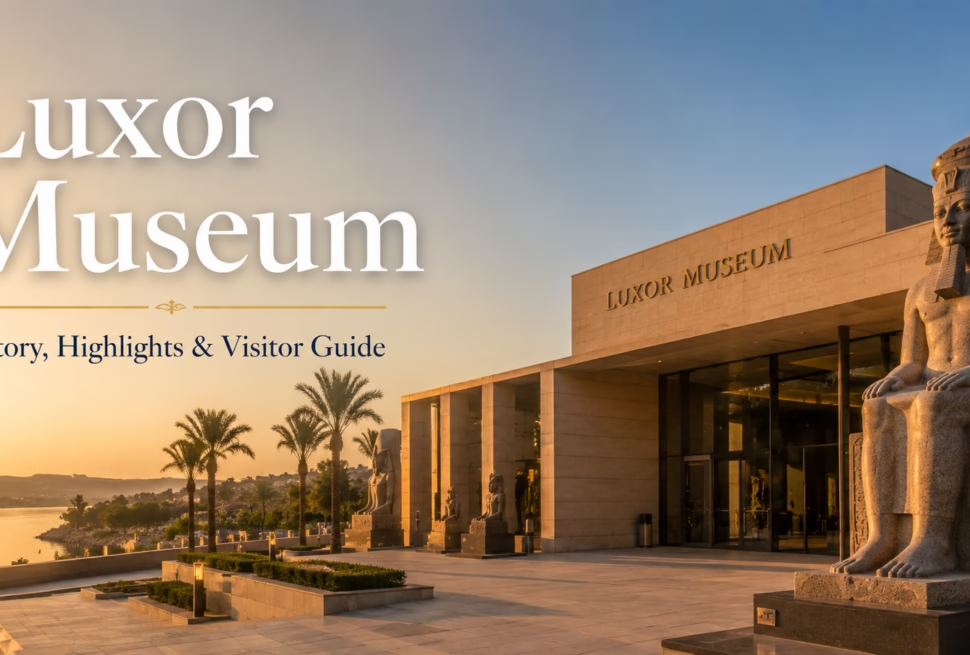
And do not skip the museums. Seeing statues and coffins up close at the Grand Egyptian Museum or the Luxor Museum makes the gods and crowns on temple walls much easier to recognise afterwards.
See the temples with an Egyptologist
A guidebook gets you started. A good Egyptologist guide, who can stand with you in front of a wall and explain exactly what you are looking at, makes it unforgettable. Every Nile cruise and tour we arrange includes a qualified Egyptologist guide for your sightseeing, and on our private tours you can ask them to slow down, stop at one wall for as long as you like, and teach you to read it.
- On a cruise: compare our Nile cruises between Luxor and Aswan, covering Karnak, Luxor Temple, Edfu, Kom Ombo and Philae.
- On land: see our Egypt land tours and day tours, including the quieter West Bank and Edfu and Kom Ombo by road.
Message us on WhatsApp or send an enquiry, and tell us how much time you want at each temple. We will build the trip around it.
“Not sure which cruise to choose? Tell us your dates and budget.”
Not sure which Nile cruise is right for you?
Answer a few quick questions and we will match you with the best ships for your trip.