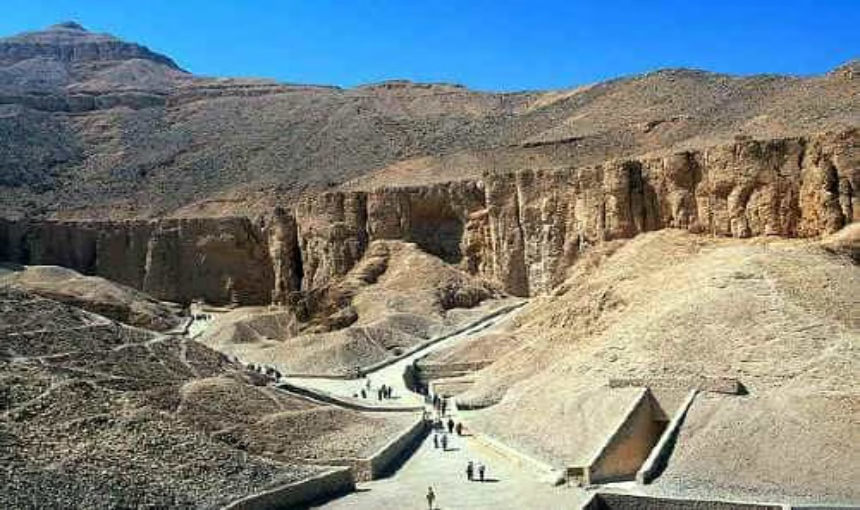
The Valley of the Kings understandably draws the biggest crowds on Luxor’s West Bank, but it is only one part of a far larger necropolis. Scattered across the same stretch of desert are the lesser-visited Tombs of the Nobles, where painted scenes of daily life replace the royal funerary texts of the pharaohs’ tombs, offering a genuinely different and often quieter experience. This guide covers what to see beyond the Valley of the Kings and how to fit it into a Luxor stop.
“Want a deeper West Bank itinerary added to your cruise? Ask us how.”
What Are the Tombs of the Nobles?
Unlike the Valley of the Kings, reserved for pharaohs and their families, the Tombs of the Nobles across Luxor’s West Bank belonged to officials, priests, architects, and other high-ranking figures from the New Kingdom and beyond. Because these tombs were not built for royalty, their decoration tends to focus less on the formal religious texts found in royal tombs and more on vivid, colorful scenes of everyday life: banquets, farming, hunting in the marshes, musicians, and family gatherings. For visitors who want to understand what daily life actually looked like in ancient Egypt rather than only its funerary religion, these tombs are often more rewarding than another royal tomb, and they are visited by only a fraction of the crowds that pass through the Valley of the Kings on any given day.
Notable Tombs Worth Seeking Out
Among the most celebrated are the tombs of Sennedjem and Inherkha at Deir el Medina, the village of the artisans who built the royal tombs, both renowned for their exceptionally well-preserved, jewel-toned wall paintings. The tomb of Rekhmire, a vizier under Thutmose III, is famous for detailed scenes of foreign tribute bearers and craft workshops, while the tomb of Nakht, a scribe and astronomer, is celebrated for its lively banquet and harvest scenes. Because these tombs are smaller and less visited, many operate on a rotating access basis, with a subset open to the public at any given time, so it is worth checking current access with your guide rather than planning around a specific tomb months in advance.
Other West Bank Highlights Beyond the Tombs
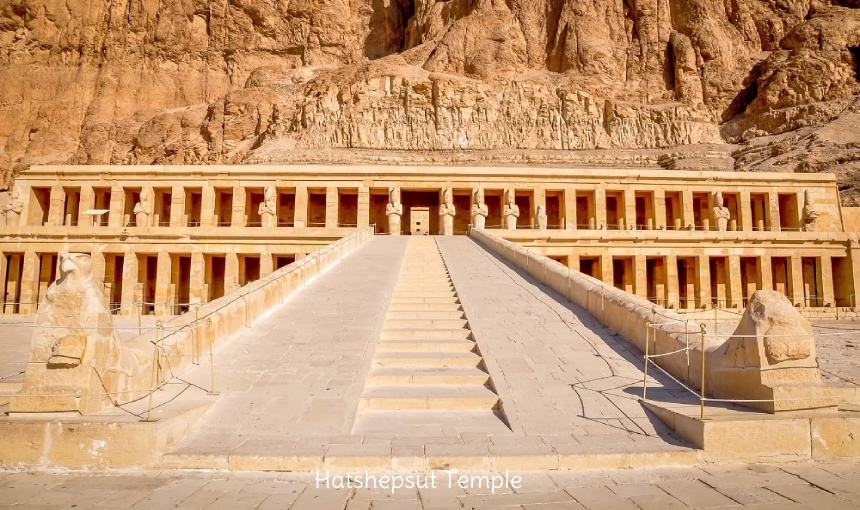
The West Bank holds far more than tombs. The Valley of the Queens sits close by, along with the mortuary temples of Hatshepsut and Ramses III at Medinet Habu, the towering Colossi of Memnon standing alone in the fields, and the remains of the Ramesseum, Ramses II’s memorial temple. Deir el Medina itself, the actual village where the royal tomb builders lived, offers a rare look at ordinary workers’ housing rather than only monumental architecture. Together, these sites make the West Bank easily worth a full day, or split across two mornings, rather than a single rushed visit squeezed in around the Valley of the Kings.
Practical Tips for Visiting
Photography is restricted or requires an additional ticket in many tombs, so check the current rules with your guide before assuming you can photograph the interiors. Many of the smaller tombs are compact, with steep or narrow stairways, so comfortable shoes matter more here than almost anywhere else on a standard itinerary. Early morning visits are strongly preferred, both to beat the heat inside stone chambers with limited ventilation and to avoid the crowds that build up at the more famous sites by mid-morning.
Planning Your Luxor Stop
If your cruise itinerary allows for a full day in Luxor rather than a rushed half day, asking your guide or cruise operator to include one or two Tombs of the Nobles alongside the standard West Bank stops is a worthwhile request. For the headline sites, see our guides to the Valley of the Kings, Hatshepsut Temple, and Deir el Medina.
More on Luxor’s West Bank
- The Ramesseum
- Medinet Habu
- Valley of the Queens
- The Colossi of Memnon
- Luxor Museum
- Mummification Museum in Luxor
Why the Decoration Is So Different
The contrast between a royal tomb and a noble’s tomb is not a matter of budget but of purpose, and once you understand it the Tombs of the Nobles become much more rewarding.
A pharaoh’s tomb in the Valley of the Kings was decorated with funerary texts: the Book of the Dead, the Amduat, the Book of Gates. These are technical religious documents mapping the sun god’s journey through the twelve hours of night and the king’s passage alongside him. They are dense, formal and repetitive by design, because their function was to work rather than to charm.
Nobles were not divine and did not travel that particular road. Their tombs instead depict the life they hoped to continue: the estate they managed, the banquets they hosted, the fields they oversaw, the crafts practised in their workshops. The result is an accidental documentary record of ancient Egyptian daily life that no royal tomb provides.
You see grape harvesting and wine making, cattle being counted, fishing in the papyrus marshes, musicians and dancers at a feast, women adjusting jewellery, scribes recording tallies, and children playing. Much of what Egyptologists know about ordinary ancient life comes from these walls.
The Tomb of Nakht
Nakht was a scribe and astronomer of Amun during the Eighteenth Dynasty, and his tomb is small but among the most charming on the West Bank. The banquet scene is justly famous, showing three female musicians playing harp, lute and double pipe, painted with a fluidity that feels startlingly immediate.
Agricultural scenes cover ploughing, sowing and harvest, and there is a well known depiction of grape treading. The tomb is compact, so groups move through in rotation, but the concentration of quality in a small space makes it efficient to visit.
The Tomb of Rekhmire
Rekhmire served as vizier under Thutmose III and Amenhotep II, effectively running the country’s administration, and his tomb reflects that reach.
The most celebrated scenes show foreign tribute bearers arriving from Nubia, Punt, Syria and the Aegean, each rendered with distinct dress, hairstyles and goods, which makes the tomb an important source for Egypt’s international contacts. Elsewhere, craft workshops show metalworkers, carpenters, leather workers and sculptors at their tasks in sequence, close to a technical manual in paint.
The chapel is unusually tall and narrow, with a ceiling rising as it goes deeper, which is worth noticing as you walk in.
Sennedjem and Inherkha at Deir el Medina
These two tombs belong to a different category again, because the men buried in them were the artisans who decorated the royal tombs. When they came to decorate their own, they were working at the top of their craft for themselves.
Sennedjem’s burial chamber is small, vaulted and almost perfectly preserved, with colours so intense they look recently applied. The scene of Sennedjem and his wife ploughing and harvesting in the Field of Reeds, the Egyptian afterlife, is among the most reproduced images from ancient Egypt.
Inherkha’s tomb nearby is equally fine, including a well known scene of a cat, representing the sun god, killing the serpent Apophis beneath a sacred tree. Both tombs are tiny and access is limited to small numbers at a time, which is precisely why the paint has survived as it has.
Ramose, Userhat and Khonsu
The tomb of Ramose, a vizier under Amenhotep III and Akhenaten, is historically significant for capturing a moment of transition. Part of the decoration follows traditional conventions in exquisite raised relief, while another part shows the elongated, naturalistic Amarna style introduced under Akhenaten. Seeing both in one chamber is a compressed lesson in one of the strangest periods in Egyptian history.
Userhat and Khonsu are smaller but each holds distinctive scenes, and because visitor numbers here are low you can often stand alone in a painted chamber, which is essentially impossible in the Valley of the Kings.
Which Tombs Are Open
Access rotates. Egyptian authorities open and close individual tombs periodically to manage humidity, conservation work and visitor pressure, so the specific tombs available on any given day are not guaranteed months ahead.
Practically, this means you should not build your expectations around one specific tomb. Tell your guide what interests you, whether that is daily life scenes, workmanship or the Amarna transition, and let them advise on what is open when you arrive. Tickets for the Tombs of the Nobles are sold in groups covering two or three tombs rather than individually.
Photography rules vary between tombs and change periodically, with some requiring a separate photography ticket and others prohibiting cameras entirely to protect the pigments. Flash is universally banned and this is enforced.
Building a Fuller West Bank Day
A standard cruise excursion covers the Valley of the Kings, Hatshepsut Temple and the Colossi of Memnon in a single morning, and that is a reasonable introduction. If you have a full day, or are willing to trade one site for another, the West Bank supports far more.
A rewarding fuller itinerary might run: Valley of the Kings early, before the heat and the crowds; two or three Tombs of the Nobles mid morning; Deir el Medina with Sennedjem’s tomb and the workers’ village; a break; then Medinet Habu in the afternoon, which is enormous, well preserved and startlingly quiet compared with the morning sites.
The Ramesseum, Ramses II’s memorial temple, is worth including if time allows. Its toppled colossus inspired Shelley’s poem Ozymandias, and standing among the fallen fragments carries a weight that the better restored sites do not quite match.
Practical Notes for Visiting
- Go early. The West Bank has almost no shade and tomb interiors are unventilated, becoming genuinely uncomfortable by late morning in warm months
- Wear proper shoes. Tomb access involves steep steps, low ceilings and uneven ground
- Bring cash. Additional tomb tickets and photography permits are bought at the site
- Carry water. Distances between site entrances and tombs are longer than they look
- Be realistic about numbers. Three or four tombs visited attentively beats eight rushed
- Consider claustrophobia. Some chambers are small, low and reached by narrow descending corridors
Is It Worth Trading a Famous Site?
For a first visit to Egypt, the Valley of the Kings earns its place and should not be skipped. But travellers frequently report that the tombs they remember most vividly are the small painted chambers at Deir el Medina or a noble’s banquet scene, precisely because they were able to stand quietly and actually look.
If your itinerary allows only one morning, ask your guide whether swapping one royal tomb for two Tombs of the Nobles is possible. The royal tombs are grander in scale and architecture. The nobles’ tombs are better preserved in colour, far less crowded, and tell you what ancient Egyptian life actually looked like rather than what its religion required. Seeing both is what makes the West Bank coherent.
This site is part of our complete guide to every temple and historical site on a Nile cruise.
“Not sure which cruise to choose? Tell us your dates and budget.”
Not sure which Nile cruise is right for you?
Answer a few quick questions and we will match you with the best ships for your trip.